Launch pricing: the full kit is $27 while we're new Launch pricing: the full kit for $27
Barbering Made Simple Illustrated study guides · NIC and PSI National
Bonus: The Words of Barbering cover Book 1: Barbering Theory Illustrated cover Book 2: Rapid Review Cards cover

The Easiest Way to Learn Barbering Without the Fluff

The essential study guide for barber students and apprentices who need to understand the theory in a clear, visual, and easy-to-remember way.

Secure Purchase Encrypted Checkout 7-Day Guarantee

Here's what the pages look like

Swipe through real pages from the kit. Every page is one idea, one drawing, and the exam areas it belongs to.

What's included

3 illustrated books

A 120-page theory book that covers the national outlines one idea at a time, 60 rapid review cards, and a bonus A to Z of 100 key terms.

One idea per page

A drawing does the explaining, and the text stays short. You remember the picture on exam day.

Made for your phone

Portrait pages sized for a phone screen. Study between clients, on the bus, or after the shop closes. Print them if you prefer paper.

About 1 in 2 don't pass

That's roughly how many barber written exam attempts end in a fail, and in Texas it's worse. Most candidates pass the practical. The written is where they get stopped, and the topics that stop them are the ones that are easy to mix up and hard to memorize.

Infection control and safety

Cleaning vs. disinfecting vs. sterilizing, blood exposure, and what goes in the jar. The largest single area on the PSI and Texas outlines, and the first thing NIC lists.

Shaving and razor work

The service you do with your hands, tested as theory: strokes, angles, honing and stropping, and the skin conditions that stop a shave.

Chemical services

Color, lightening, relaxers and perms. The services many barbers rarely do in the shop, and one of the areas where test takers score lowest.

Skin and scalp disorders

Which conditions you can work on and which you refer out. The look-alike names are the trap.

Sources: California BBC 2026 Sunset Review: 55% of first-time barber written candidates passed, FY2021/22 to FY2024/25. Texas TDLR, FY2025: 5,307 of 8,457 Class A Barber written exam sittings failed; 2,669 of 2,972 practical sittings passed. PSI, Dec 2022: lowest scores in skin care, chemical services and haircutting.

Same content. A very different night of studying.

From this

Walls of textbook text

  • You reread the same paragraph three times
  • Every term looks like every other term
  • Gone by exam day

Chapter 5: Infection Control, Principles and Practices

Decontamination is the removal of blood or other potentially infectious materials from an item's surface and the removal of visible debris or residue such as dust and dirt. There are two methods of decontamination. Method 1 is cleaning followed by disinfecting with an appropriate EPA-registered disinfectant, and method 2 is cleaning followed by sterilization. Cleaning is a mechanical process using soap and water or detergent and water to remove all visible dirt, debris, and many disease-causing germs. Cleaning also removes invisible debris that interferes with disinfection. Cleaning is what barbers are required to do before disinfecting. Disinfection is a chemical process that uses specific products to destroy harmful organisms, except bacterial spores, on environmental surfaces. Disinfectants are products that destroy most bacteria, fungi, and viruses but not spores on surfaces. Disinfectants used in barbershops must be bactericidal, virucidal, and fungicidal, and in most states must also be approved for use in hospitals. Sterilization is the process that completely destroys all microbial life, including spores. Sterilization is required in only a few states, and the equipment, usually an autoclave, must be tested regularly with a spore test to confirm that it is working. The three types of infection control professionals must be familiar with are sanitation, disinfection and sterilization, and the level of each depends on the implement, the service and state rules, which vary considerably and must be reviewed by every licensee in the state in which they practice.

Contact time is the amount of time the surface must stay visibly wet with disinfectant for the product to be effective, as stated on the manufacturer's label. Immersion in a disinfectant is required for implements such as combs, shears, clipper guards and razors with reusable handles, while clipper blades that cannot be immersed are cleaned and then sprayed with an appropriate disinfectant and allowed the full contact time. Single-use items, including neck strips, razor blades, and cotton, are discarded after one use. The Safety Data Sheet (SDS), formerly the Material Safety Data Sheet (MSDS), is required by OSHA for every product used in the shop and lists hazardous ingredients, safe use and handling, precautions, and first aid, and it must be available to all employees...
To this

One idea per page

  • The drawing explains it
  • The trap is named in plain words
  • You remember the picture

You're studying for one outline, not a whole textbook

Most states use one of two national theory exams. Both publish their outline and weights. The kit is organized by both, so every page tells you where it sits on each.

NIC National Barber Styling Theory

The NIC exam most states use. NIC Barber and NIC Barber 1 (no chemical services) use the same domains with 60 questions, 50 scored.

110questions, 100 scored
90minutes, about 49 seconds each
4domains, weighted below
  • Hair Care Services40%
  • Scientific Concepts35%
  • Facial Hair and Skin Care Services15%
  • Implements and Equipment10%

PSI National Barber Theory

Used in California, Georgia, Colorado, Alabama, Tennessee and other PSI states.

95questions, 85 scored
120minutes, about 76 seconds each
8areas, weighted below
  • Safety and Infection Control31%
  • Shaving22%
  • Client Consultation, Hair and Skin Analysis15%
  • Haircutting8%
  • Haircoloring7%
  • Chemical Texture Services7%
  • Hairstyling5%
  • Skin Care5%

Sources: NIC National Barber Styling, Barber and Barber 1 Theory candidate information bulletins effective June 1, 2025 (revised September 1, 2025). PSI Barber test taker guides, 2026 editions (Georgia, California, Colorado, Alabama). Passing scores, fees and retake rules are set by your state.

Stop rereading the same chapter

Barbering theory is full of near-twins. The kit puts them side by side, names the mix-up, and gives you a hook to keep them straight.

Disinfect vs. sterilize

One kills most germs on a surface. The other kills everything, spores included. Only one needs an autoclave.

Hone vs. strop

One sharpens a dull edge. The other smooths it before every shave. Edge first on the hone, back first on the strop.

Folliculitis vs. pseudofolliculitis

One is an infected follicle. The other is an ingrown hair, the razor bump. One word apart, two different calls in the chair.

EPA vs. FDA vs. OSHA

Three agencies, three jobs: the disinfectant, the products, and the worker. Easy to swap under time pressure.

Every page carries an Exam Trap, and every page with a real memory hook carries one:

Exam trap

Honing sharpens, stropping does not. On the hone the edge leads; on the strop the back leads and the edge trails.

Memory hook

Edge into the stone, back along the leather.

Quoted word for word from Book 1, page 51, Honing and stropping.

The three books

Book 1: Barbering Theory Illustrated

One idea per pageNIC and PSI tagsExam TrapsMemory Hooks

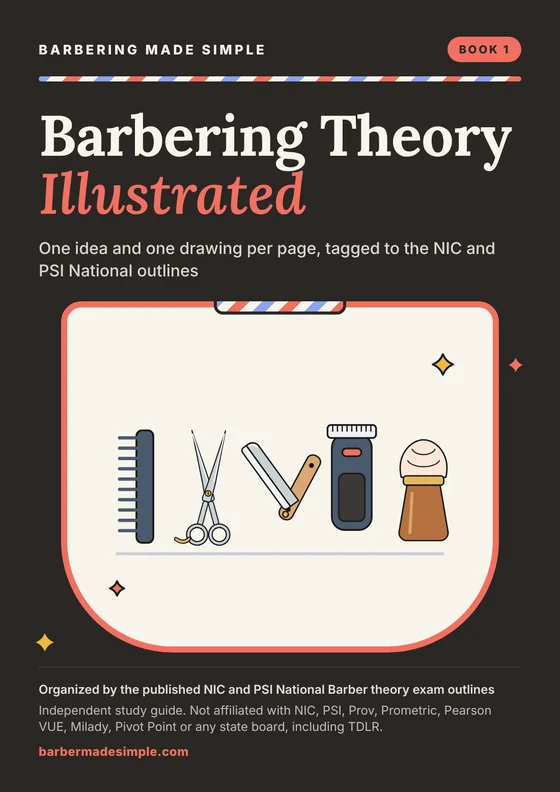
The theory book. 120 pages, one idea and one drawing per page, from infection control and blood exposure to anatomy, the skin and scalp disorders a barber refers out, tools and clipper care, haircutting, shaving and facial hair design, and chemical services.

  • Every page carries its NIC domain and its PSI area (or "Not in PSI's outline"), so you know where it sits on your exam.
  • Pages on chemical services say they are not on NIC Barber 1.
  • An Exam Trap on every page, and a Memory Hook wherever a real one exists.
  • Up front: how to use the book, the exam at a glance, a state lookup with a "checked on" date, and what's state-specific.

Book 2: Rapid Review Cards

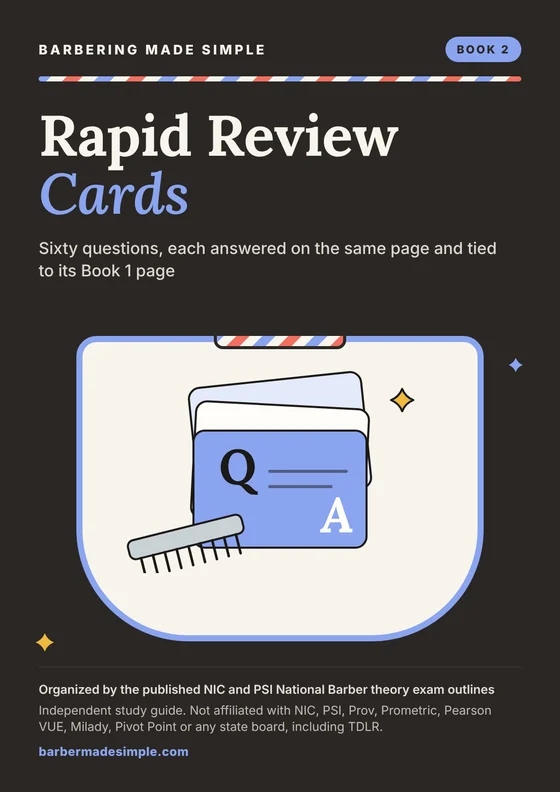
60 cardsQuestion and answerPoints to Book 1

60 cards, one per page: the question on top, the answer and a small drawing below, and the Book 1 page to go back to if you missed it. For the last week before your test date.

Bonus: The Words of Barbering

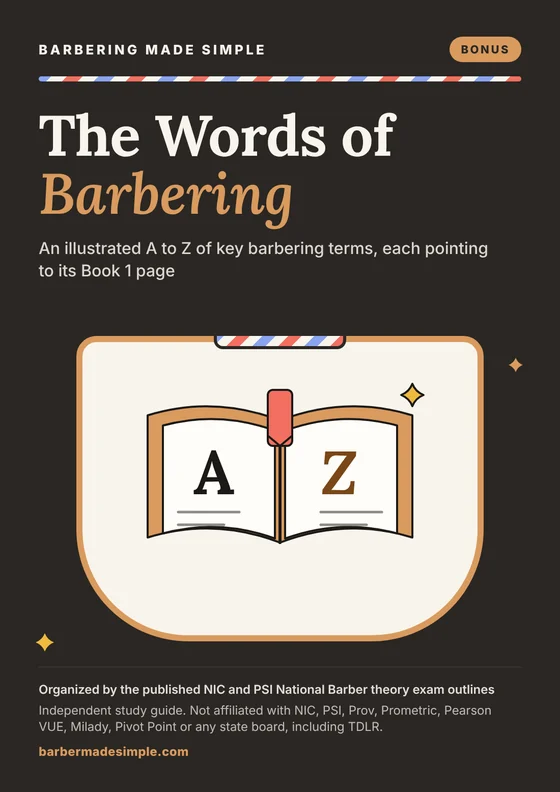
100 termsIllustrated A to ZPoints to Book 1

An illustrated A to Z of 100 key terms. Each one gets a plain-English definition, the near-twin or mix-up to know, and its Book 1 page.

Here's everything you get

Bonus: The Words of Barbering Book 1: Barbering Theory Illustrated Book 2: Rapid Review Cards
  • Book 1: Barbering Theory IllustratedOne idea and one drawing per page, with a state lookup up front
  • Book 2: Rapid Review Cards60 cards, question on top and answer below, each pointing to its Book 1 page
  • Bonus: The Words of BarberingAn illustrated A to Z of 100 key terms, in plain words
Launch price
$27

One-time payment. No subscription. Keep the files forever.

Yes, I want the kit for $27
Secure Purchase Encrypted Checkout 7-Day Guarantee
Payments by Stripe

Digital books (PDF). We email your download link right after purchase, and your library lets you download them again anytime. Plus sales tax where applicable.

Is this kit for you?

You're in barber school

Your program ends with the written and the practical, and the written is getting close. You need the theory to finally click, not another chapter to reread.

You study between clients

Work, family, shop hours. Your study time is ten minutes on your phone. One page, one idea, done.

Your test date is booked

The material is in your head somewhere. Now you need it organized the way the exam outline lays it out.

How this kit is made

No gimmicks and no shortcuts. Just the published outlines, drawn clearly.

Built on the published outlines

Every page starts from the NIC Barber theory outlines and the PSI National Barber outline, and uses the same terms as the standard barbering textbooks.

Honest about the gray areas

Where sources disagree, or a rule varies by state, the page says so in plain words instead of picking one answer and hoping.

Mapped, not padded

Each page carries its NIC domain and its PSI area. Nothing is in the kit because it filled a page.

Independent, on purpose

Not affiliated with NIC, PSI, Prov, Prometric, Pearson VUE, Milady, Pivot Point or any state board. We answer to the people studying, not to a publisher.

7-day money-back guarantee

Use the kit for 7 days. If it doesn't help you, email us and you get 100% of your money back. No fine print, no hassle.

Questions, answered

How will I receive the books?

Right after purchase we email you a link to your library, where you download all three PDFs. You can come back and download them again anytime.

Is this a one-time payment or a subscription?

One-time payment of $27. No subscription, no recurring charges.

Which exam does this cover?

The written (theory) exam. The kit is organized by the NIC Barber theory outlines and the PSI National Barber outline, and every page carries both tags. It doesn't cover the practical exam.

Does it cover NIC Barber 1 (no chemical services)?

Yes. NIC Barber 1 uses the same domains without the chemical services section. Every page on color, lightening or chemical texture is marked "not on NIC Barber 1", so you know what to skip.

Does it include my state's laws and rules?

No. State laws and board rules vary too much to cover responsibly in one book. Book 1 has a page that explains what is state-specific, and the state lookup tells you whether your state adds law questions or a separate law exam. See which states this covers.

Can I study on my phone?

Yes. The pages are portrait, phone-sized, and built around one idea each. They print fine too.

Is this affiliated with NIC, PSI, Milady or my state board?

No. Barbering Made Simple is an independent study aid built from the publicly available exam outlines. It uses standard industry terminology and is not affiliated with, endorsed by, or sponsored by NIC, PSI, Prov, Prometric, Pearson VUE, Milady, Pivot Point, or any state barber board, including TDLR.

What if it doesn't help me?

Email us within 7 days of purchase and we'll refund 100% of your money. Details on the refund policy page.

Which states does this cover?

Most states use one of two national theory exams, and a few write their own. Here is how the kit lines up with each, honestly.

NIC states

The kit covers the national theory your exam is built on. A few NIC states add their own law questions or a separate rules exam, which the kit doesn't include.

Covers the national theory

PSI National states

The kit covers the national theory your exam is built on, with every page tagged to the PSI area it belongs to.

Covers the national theory

States that write their own exam

Texas, Florida, Pennsylvania, Ohio, Oregon and a few others. The kit covers the core theory those exams share with the national outlines. Your state's laws and rules are not included.

Covers the core concepts

Checked against state boards and vendor bulletins on October 13, 2026. Exams change, so always confirm with your state board and your candidate bulletin before you register. Book 1's state lookup carries the full list with its "checked on" date.

One last thing before you decide

The written doesn't have to be the scary part of getting licensed. You don't need to reread the textbook. You need to see how the material fits together, the way the exam outline lays it out.

Get instant access
Access confirmed ·
Full kit $27Get instant access
The full kit · $273 illustrated PDFs · 120-page theory bookGet instant access